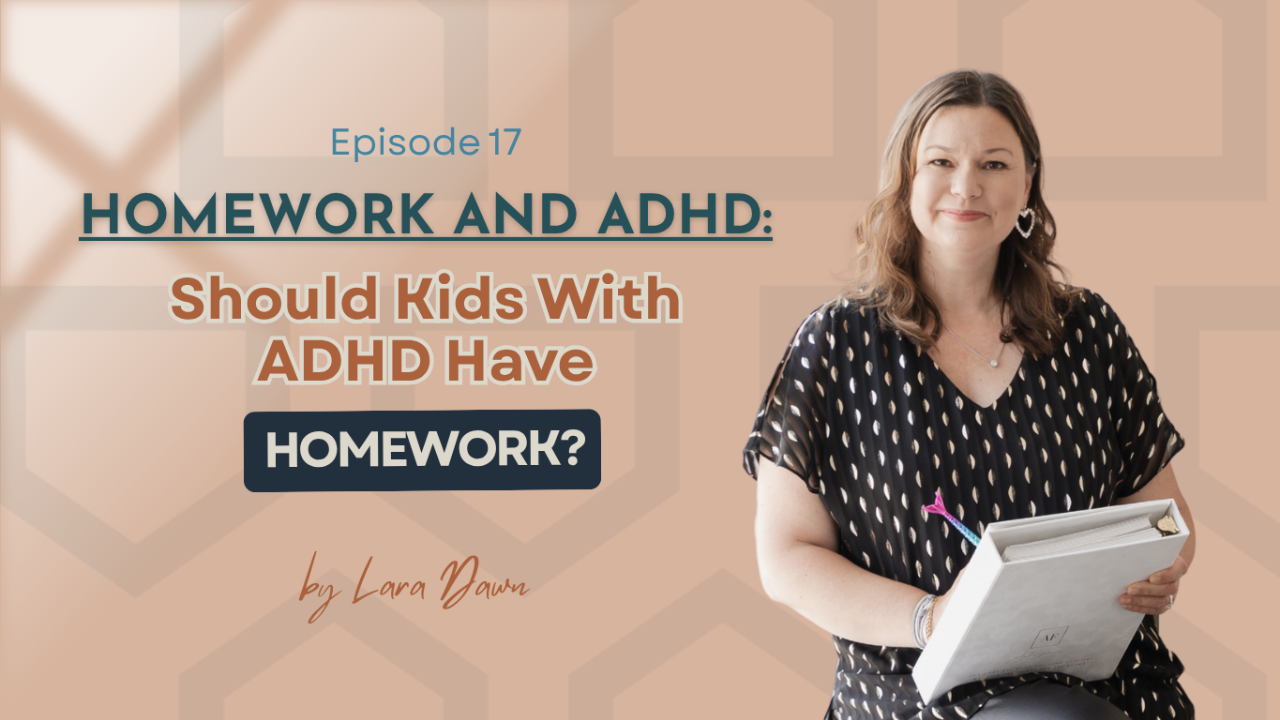
Why Is Homework So Hard for Kids With ADHD?
Sep 04, 2026If homework is hijacking your evenings, I want you to consider a possibility you may not have been given permission to consider:
Maybe the problem isn't your child.
Maybe the expectation needs another look.
I've spent 25 years as an elementary school teacher, including 10 years in special education. I'm also a mother who has lived the other side of the kitchen table.
And I've watched homework turn perfectly capable children into kids who believe they aren't capable at all.
Homework isn't “just homework” for an ADHD brain
Think about what a child may have to do before a single answer gets written.
Remember the assignment.
Find the materials.
Stop doing something more interesting.
Initiate the task.
Figure out where to begin.
Hold instructions in working memory.
Ignore distractions.
Manage frustration.
Sustain attention.
Check the work.
Remember to put it back in the backpack.
That's an executive-function obstacle course.
So when a child avoids homework, melts down or takes two hours to complete something another child finishes in twenty minutes, “They just need to try harder” is rarely a useful explanation.
Dr. Ross Greene's philosophy offers parents a different starting point:
Kids do well if they can.
Instead of asking, Why won't my child do this?, we can become curious:
What's getting in the way?
But doesn't homework teach responsibility?
Maybe.
But responsibility isn't owned by homework.
Children can learn responsibility by feeding a pet, contributing to their home, remembering soccer equipment, caring for belongings, saving money, practising an instrument, showing up for a team or eventually having a job.
So rather than asking whether homework teaches responsibility, ask:
What skill am I actually trying to develop?
And:
Is there another way my child could develop it?
What does the homework research tell us?
The research becomes more supportive of homework as children get older. The academic benefit is much less compelling in the elementary years than it is in secondary school.
That doesn't mean homework is universally bad for younger children.
It means context matters.
Purpose matters.
Amount matters.
The child matters.
And a guideline suggesting a certain amount of homework doesn't account for a child whose executive-function differences turn twenty minutes of expected work into ninety minutes of distress.
Learning is bigger than worksheets
Montessori, homeschooling and unschooling offer useful challenges to our conventional definition of learning.
A child can learn through cooking.
Building.
Reading.
Gardening.
Playing.
Creating.
Taking something apart.
Managing money.
Following an obsession down an internet rabbit hole and emerging three hours later knowing everything there is to know about black holes.
Learning didn't disappear because the worksheet disappeared.
The Warrior Mama question
This is where the conversation becomes bigger than homework.
We live in a world overflowing with expert opinions.
Teachers tell us one thing.
Parenting experts tell us another.
Instagram tells us something else before breakfast.
Eventually, mothers can become so busy collecting advice that they stop hearing themselves.
Being a Warrior Mama doesn't mean rejecting expertise.
And it doesn't mean marching into school ready for battle.
It means gathering information, understanding your child, listening deeply and then having the courage to lead.
Sometimes your child needs an accommodation.
Sometimes they need a break.
Sometimes they need more structure.
Sometimes they need accountability.
Sometimes they need you sitting beside them.
And sometimes they need someone to finally say:
This isn't working. Let's find another way.
There is no one right brain.
There is no one right child.
There is no one right answer.
Ask yourself:
What is this homework giving my child?
What is it costing my child?
Then listen carefully to the answers.
Because we're not raising compliance machines.
We're raising humans who will eventually need to understand their own brains, recognize what they need and advocate for themselves.
Support the disability. Protect the design. Evolve the environment.
Listen to Episode 17 of The evOLVED Brain for the full conversation.
Listen to the Full Episode
If you’ve ever wondered why your child can do hard things they love but can’t seem to start a simple homework assignment, this episode is for you.
You’ll walk away with practical tools, a deeper understanding of ADHD, and far more compassion for both your child and yourself.
🎧 Listen to Episode 17 of The evOLVED Brain today: https://www.theadhdvillage.com/PodPartytheEvolvedBrain
Ready to Go Deeper?
If you’re looking for a community of parents learning to regulate themselves while raising extraordinary neurodivergent kids, we’d love to welcome you into our ADHD Village: https://www.theadhdvillage.com/
Because sometimes the most important thing we can change isn’t our child.
It’s the environment we create around them.