If Your ADHD Child Melts Down Over Small Things, Read This
Mar 17, 2026If Your ADHD Child Melts Down Over Small Things, Read This
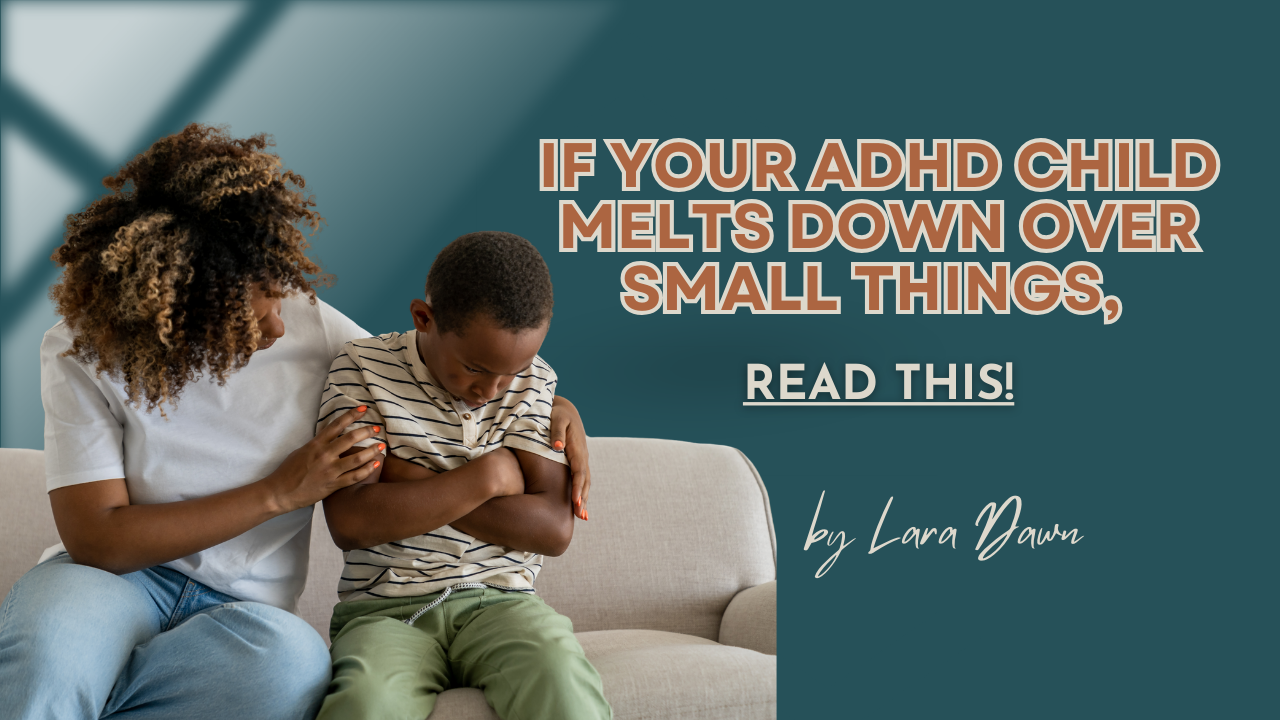
If your child melts down over something that seems small…
It’s not manipulation.
It’s physiology.
The spilled water bottle.
The wrong socks.
The homework reminder.
The transition from screen to dinner.
To you, it looks disproportionate.
To their nervous system, it feels overwhelming.
And that distinction changes everything.
What’s Actually Happening in the ADHD Brain
When your child is stressed, frustrated, or overstimulated, their brain shifts into survival mode.
Here’s what that means in simple terms:
- The amygdala activates. This is the brain’s alarm system.
- Stress hormones increase.
- The prefrontal cortex, the part responsible for logic, impulse control, and problem-solving, goes offline.
- Executive function skills shut down.
If your child has ADHD, this system is already more sensitive.
ADHD is associated with differences in dopamine regulation and executive function development. That means transitions, disappointment, or frustration can hit harder and faster.
When the brain feels unsafe, it prioritizes survival over reasoning.
And here’s the line I want you to remember:
The brain cannot access logic when it feels unsafe.
So when you say, “Calm down,” or “It’s not a big deal,” you’re speaking to a part of the brain that isn’t online in that moment.
They aren’t choosing to escalate.
They’re dysregulated.
Why “Calm Down” Doesn’t Work
Cognitive skills require regulation.
Perspective-taking, flexibility, emotional control, and problem-solving all live in the prefrontal cortex.
But regulation precedes reasoning.
Connection precedes cooperation.
When we try to correct behaviour before calming the nervous system, we are asking a brain in fight-or-flight to perform a task it literally cannot access.
That’s why lectures don’t work in the middle of meltdowns.
That’s why consequences often escalate instead of resolve.
The intervention is not louder control.
It’s regulation.
What Regulation Looks Like in Real Life
Regulation is not permissiveness.
It is leadership.
It looks like:
- Lowering your voice instead of raising it
- Moving closer instead of farther away
- Offering proximity without pressure
- Using short, simple language
- Building in movement breaks before transitions
- Increasing novelty and dopamine intentionally
It might sound like:
“You are safe.”
“I’m here.”
“Let’s take a breath together.”
You are not rewarding the meltdown.
You are stabilizing the nervous system.
And once the nervous system is stable, learning becomes possible.
The Parent’s Nervous System Is the Lever
This is the part no one talks about enough.
Your child’s regulation is directly influenced by yours.
Nervous systems mirror each other.
When you escalate, they escalate.
When you ground, they borrow your calm.
The regulated parent is the intervention.
This doesn’t mean you never feel frustrated.
It means you learn to pause before reacting.
It means you build emotional intelligence in yourself.
It means you lead the moment instead of being pulled by it.
This is nervous system leadership.
And it is the foundation of everything I teach.
The Shift
For weeks, I’ve been writing about this shift:
From deficit to design.
From fear to future.
From correction to regulation.
This is where it becomes practical.
ADHD is not primarily a behaviour problem.
It is a nervous system regulation issue.
When we regulate first, everything changes.
Meltdowns shorten.
Recovery speeds up.
Trust builds.
Executive function strengthens.
Not overnight.
But consistently.
Soon, I’ll be expanding this conversation in a new way - diving deeper into the evolved brain and what it truly needs to thrive.
For now, I want to ask you:
What triggers you most in your child’s behaviour?
Is it the intensity?
The defiance?
The repetition?
The emotional explosions?
I’d love to hear from you. Share in my private FB group, The ADHD Village.
Because when we understand the physiology, we stop taking it personally.
And when we stop taking it personally, we start leading differently.
The future belongs to evolved minds.
And evolution begins at home.