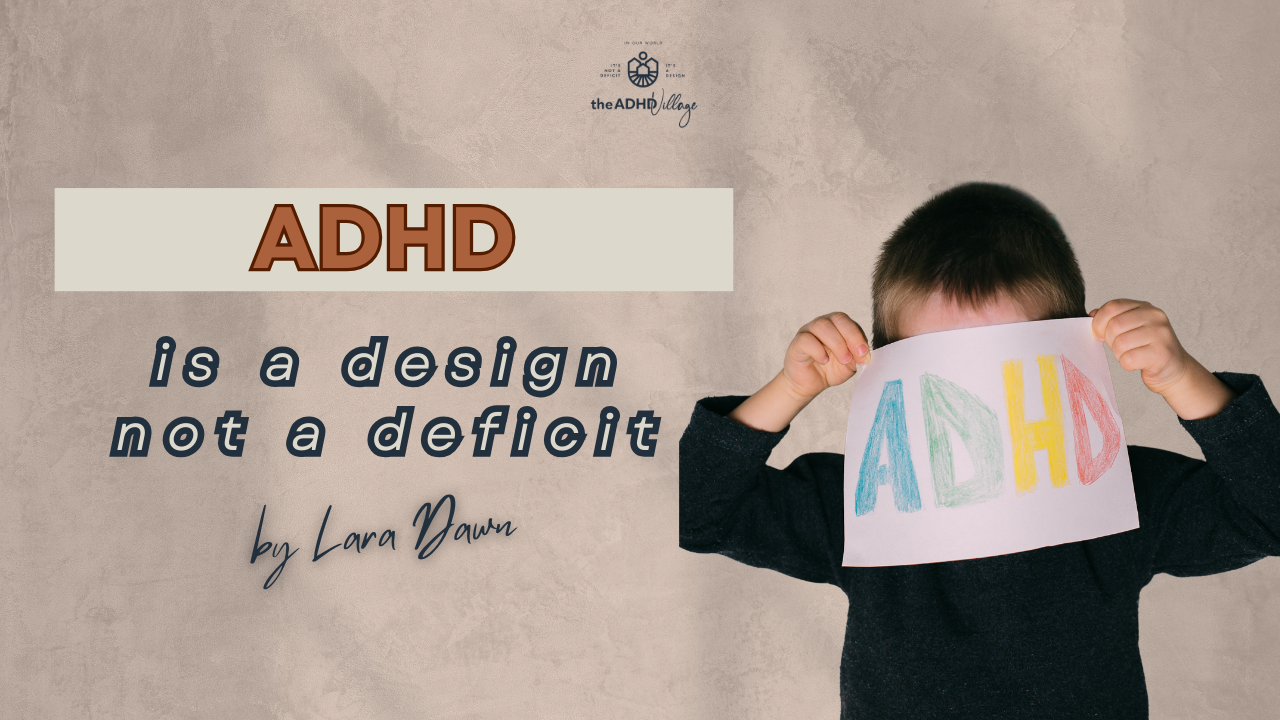
ADHD Is Not a Deficit. It's a Design.
Mar 03, 2026ADHD Is Not a Deficit. It’s a Design.
For years, we’ve been told that ADHD is a disorder.
A delay.
A disruption.
A dysfunction.
Something to manage.
Something to fix.
Something to outgrow.
But what if we’ve misunderstood it entirely?
What if ADHD is not a deficit…
But a different neurological design?
The Deficit Narrative Is Failing Our Kids
When a child struggles to sit still, follow instructions, or complete tasks on time, we often assume:
They aren’t trying hard enough.
They lack discipline.
They need more structure.
But neuroscience tells a different story.
Brain imaging studies consistently show that ADHD involves differences in:
- Prefrontal cortex development
• Dopamine regulation
• Cerebellar timing
• Executive function processing
This is not a moral failing.
It is wiring.
And wiring requires understanding, not shame.
Delayed Does Not Mean Damaged
Longitudinal MRI research has shown that the prefrontal cortex in children with ADHD often matures later than in neurotypical peers.
Later.
Not absent.
Not broken.
Later.
That distinction matters.
When we label a child as defective, they internalize it.
When we understand their brain develops on a different timeline, we shift from panic to patience.
Delayed development does not mean damaged development.
It means different timing.
The Mismatch Problem
Our modern systems were built during the industrial era.
Stillness.
Standardization.
Uniform pacing.
Delayed rewards.
But the ADHD brain thrives on:
- Interest
• Movement
• Immediate feedback
• Novelty
• Purpose
When those needs are unmet, behavior intensifies.
That is not dysfunction.
That is mismatch.
If you plant a sunflower in a dark closet, it will struggle. That does not mean the sunflower is flawed.
Mismatch does not equal defect.
What If We Changed the Question?
Instead of asking:
“How do I stop this behavior?”
What if we asked:
“What does this brain need to function well?”
That question changes everything.
It shifts us from correction to curiosity.
From control to collaboration.
From shame to strategy.
ADHD as Design
The ADHD brain is often:
- Fast-thinking
• Emotionally intense
• Creative
• Risk-tolerant
• Hyper-focused under interest
• Sensitive to environment
Those traits can be challenging in rigid systems.
But in the right environment?
They become strengths.
Leadership.
Innovation.
Entrepreneurship.
Athletics.
Creative industries.
The same traits that create struggle in one context create brilliance in another.
That is design.
For the Parent Reading This
If you’ve ever thought:
“Why is this so hard?”
“Am I failing?”
“Why can other families manage this better?”
Pause.
Your child is not broken.
And neither are you.
When we shift the lens, we shift the outcome.
And this is just the beginning of a much bigger conversation I’ve been preparing to share.
More soon.
For now, I want to ask you:
What strengths do you already see in your child that others overlook?
Share your child’s strengths inside our private Facebook community, The ADHD Village.
Because when we start seeing design… we start parenting differently.